Tuesday, 2 February 2016

Birding the Rhins of Galloway

I recently took a trip to the Rhins of Galloway to check out some of my favourite birding haunts. Travelling South from Glasgow I stopped along the way at Turnberry to check some roosting Shags for colour rings. Unfortunately none of the birds were ringed however the area was covered in wading birds such as Turnstone, Ringed Plovers and lots of ducks such as Eiders, Mallards and Tufted ducks. Not a bad place to stretch some weary legs! Further down the coast I stopped at another beach (again on the hunt for Shag rings or dead seabirds washed onto the beach following recent storms) and came across a lovely male Stonechat (Saxicola torquata) resting on some twigs.

Turnstone (Arenaria interpres) at Turnberry, East Ayrshire (photo Laura Shearer)
Male stonechat (Saxicola torquata) hanging around the coast (photo Laura Shearer)
Upon arrival at Stranraer I checked out the 'usual' birding spots including the local train station which ends at the old ferry port. The harbour is a real hot spot of activity for wintering GuillemotsBlack Guillemots/Tysties as well as divers, Slavonian and Great Crested Grebes. The highlight however was a beautiful female Black Redstart zipping along the ground, feeding between the old track lines.

Heading South I made my way to the Mull of Galloway where I worked last season for the RSPB. Hoping for some raptor activity, I was not disappointed as I watched a Peregrine Falcon wrestle with a Common Buzzard mid-air. Needless to say the Buzzard flew off promptly whilst the Peregrine continued to hunt for some food- what an amazing sight!

Winter plummage Black Guillemot at Stranraer Harbour (photo Laura Shearer)
Winter plummage Great Crested Grebe, Stranraer (photo Laura Shearer)
Female Black Redstart at Stranraer train station (photo Laura Shearer)

Saturday, 16 January 2016

Stormy seas

On Wednesday with a few hours to spare, I took a wander down the beaches of North Berwick to assess the impact on marine life from recent storms. Walking along I came across an eggcase from a Lesser Spotted Dogfish (Scyliorhinus canicula). Small species of shark, skates and rays lay their eggs in these protective sheaths (also known as a Mermaid's Purse) which remain well camouflaged, attached to seaweed. The young embryo develops inside and once free the eggcase often detaches and can wash up on local beaches. Using the identification guide on The Shark Trust website (Link) it is possible to determine which species the eggcase belongs to. Please also record your sightings via the page in order to allow the charity to analyse the distributions of sharks and rays in the UK.

Eggcase of a Lesser Spotted Dogfish found on a beach at North Berwick (Photo Laura Shearer)
Continuing with my walk I found large chunks of marine life washed up along the shore. Huge clumps of Laminaria kelp littered the beaches and many marine snails had dried up during the low tides. Hundreds of desiccated Dead man's fingers (Alcyonium digitatum) could be found evenly dispersed along the shore. This soft coral is brutally ripped from rocks and boulders during stormy weather and is named after their appendage-like appearance once they become dehydrated. This species can be found along the Northern Atlantic coasts of Europe and North America and comes in various shades of pink, orange, yellow, white or grey. 

Dead man's fingers washed up around North Berwick (photo Laura Shearer)
Winter storms causes the demise of many marine organisms however the consistent bad weather of recent weeks means even healthy animals struggle to cope. In the last fortnight Little Auks (Alle alle) have been well documented becoming lost and stranded around the UK with the SSPCA reporting record numbers requiring rehabilitation (SSPCA blog). Travelling South from North Berwick I came across an adult Little Auk (around the size of a Starling) which had succumbed to the weather laying at the side of the road.

Dead Little Auk, found on roadside at North Berwick (photo Laura Shearer)
Back on the beach I continued with my hunt for seabirds. Walking for almost 2 hours I seen small numbers of roosting Shags (Phalacrocorax aristotelis) however none were ringed and therefore we are unable to determine if they are local or visiting birds. Good numbers of Eider ducks (Somateria mollissima) rested on the surface close to the shore alongside a handful of Mallards (Anas platyrhynchos). Walking back to the car I stumbled across a dead Guillemot (Uria aalge) with a ring from Heligoland, Germany (awaiting feedback from study group).

Dead Guillemot found on beach at North Berwick (photo Laura Shearer)
Guillemot found on North Berwick beach was ringed in Germany (photo Laura Shearer)
If you find a ringed bird please report through the following website: http://app.bto.org/euring/main/

Friday, 8 January 2016

My 2015

Wow- has it really been over a month since my last blog?! Unfortunately life has gotten in the way with my time being occupied by work, the festive period and what feels like a never ending dose of the common cold! The joys of winter in Scotland! 

As a new year begins I have been reflecting on 2015 and all of the amazing adventures I had so I thought I would share some of my highlights:

When the year began I was volunteering at the Scottish Owl Centre in Whitburn, West Lothian (www.scottishowlcentre.com). The centre is shut to the public over the winter so we could perform essential maintenance tasks and build new aviaries for the start of a new breeding season. One of our main projects was to build a raised aviary for the Burrowing Owls (Athene cunicularia) which included a nest box camera to gain more information on their nesting behaviour. This proved to be a great success with the public enjoying excellent views of the eggs and incubation feeding live from underground during the summer months. For more information follow @ScotOwl or on Facebook Scottish Owl Centre.

Burrowing Owls enjoying their new aviary (photo Scottish Owl Centre, Facebook page)
In March I was appointed the Community Liaison Officer for the RSPB (Royal Society for the Protection of Birds) on the Mull of Galloway- Scotland's Southernmost point. The reserve boosts good numbers of seabirds including 5,000 nesting Gannets (Morus bassanus) on the Scaur Rocks several miles offshore.

The Mull of Galloway (photo Laura Shearer)

RSPB Mull of Galloway team 2015: (left-right) Iain Houston, Robert Conn and Laura Shearer
Counting Manx Shearwaters (photo Gary Prescott @bikingbirder16)
With a keen interest in bird ringing I took a bus man's holiday in June and transferred from one seabird colony to another. I joined a group of other bird ringers aiming to colour ring Shags (Phalacrocorax aristotelis) on the Forth Islands over a few days. These rings can be read from a distance and therefore makes it easier to collect information on the movements of these birds. Aiming for 400 birds over 4 islands we knew we had our work cut out for us. With a lot of determination however we ringed 626 birds including 505 with coloured darvics. Data from these birds has shown young chicks travelling as far as the Netherlands over this winter!

Colour ringing shag chicks on Craigleith (photo Laura Shearer)
Proud as punch ringing an adult shag (photo Elizabeth Morgan)
Back on the Mull of Galloway things were settling down as the seabird season and the summer holidays drew to an end. For migrating birds though- things were just getting started! Because of the location of the reserve, birds travelling South for the winter are filtered down the Rhins and eventually pass overhead. This makes it an excellent spot for visible migration during the correct weather conditions. The highlights were 1,441 Skylarks (Alauda arvensis) on 28th October observed by Pete Berry and myself during a 2.5hr count- the 8th highest UK record. Other highlights included 3,571 Meadow Pipits, Anthus pratensis, (highest site record) and 979 Linnet, Carduelis cannabina, (second highest site record) observed by Dr Clive McKay on the 30th of September. Unfortunately I had picked the wrong day off that week! Check out www.trektellen.org for full counts.

Juvenile cuckoo on migration (photo Laura Shearer)
Meadow Pipit passing through the Mull of Galloway on migration (photo Laura Shearer)

Other wildlife highlights from my year have been posted previously on my blog so feel free to check them out. My favourites include a Basking Shark (Cetorhinus maximus) at Corsewell Point, Dumfries and Galloway, White-Beaked Dolphins (Lagenorhynchus albirostris) off the coast of Northumberland and Bottlenose Dolphins (Tursiops truncatus) from the Mull of Galloway in October.
I'm excited for 2016 and look forward to continue sharing my wildlife encounters!

Sunday, 6 December 2015

Seabirds and Seals

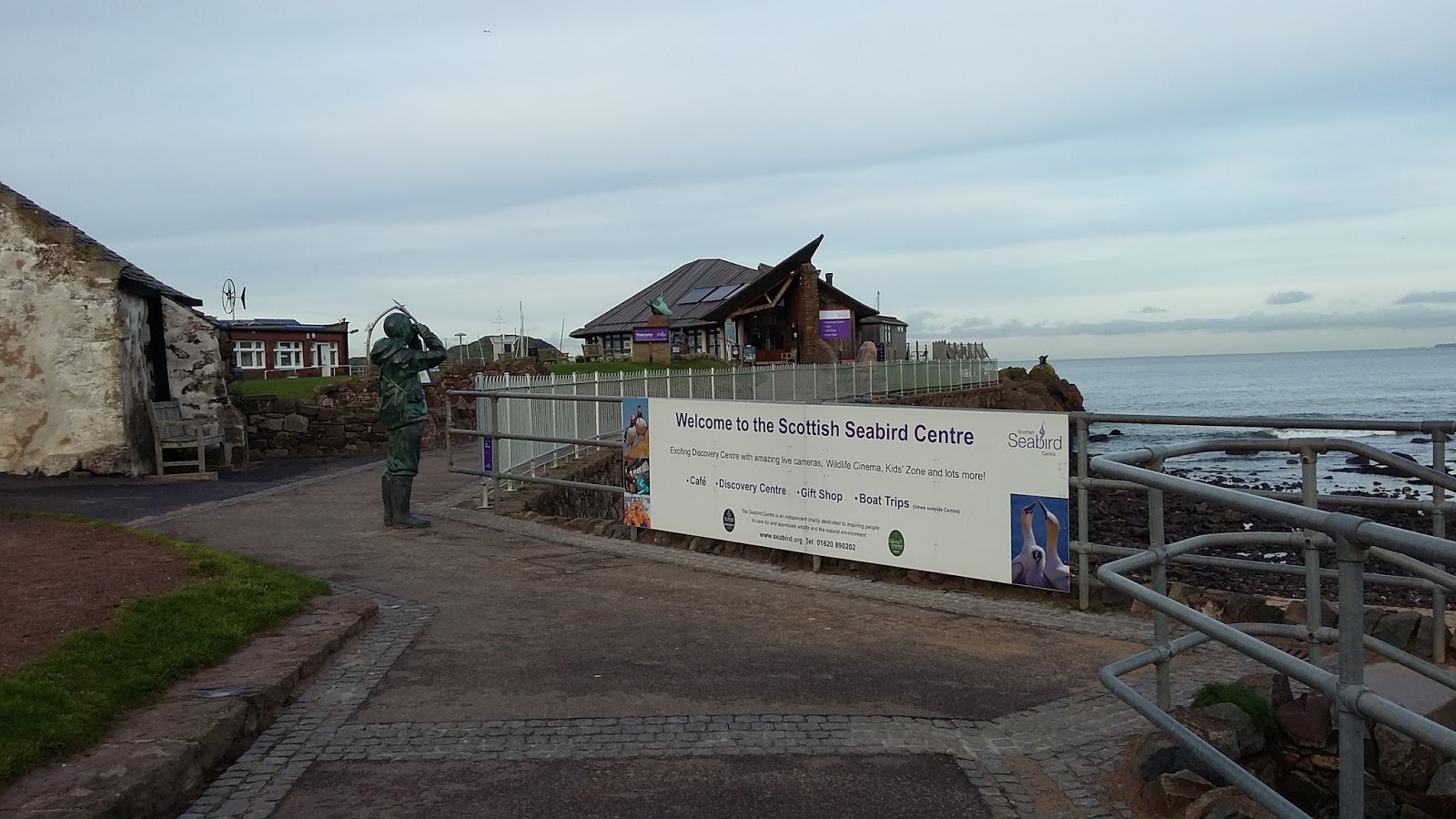
Mid-week I took a trip to the Seabird Centre in North Berwick. The last time I visited the centre I was only 15 years old and beginning to show an interest in working with nature. My dad took the family along and I remember chatting to the staff there and thinking “WOW! This is what I want to do”. Needless to say it had changed significantly since then with new displays, live feeds from the Forth islands and even a new marine tank complete with native rocky shore animals. It was fantastic to see the centre continuing to inspire new seabird fans just as it did all those years ago. Interested in learning more about the Seabird Centre check out their website including LIVE cameras from the Forth Islands: http://www.seabird.org

Scottish Seabird Centre (photo Laura Shearer)

Hermit Crab (Pagurus bernhardus) in the marine display at Seabird Centre (photo Laura Shearer)
During the autumn months grey seals (Halichoerus grypus) give birth around the UK. As a marine mammal medic for the British Divers Marine Life Rescue (BDMLR), we are called to sick or injured seal pups which may need specialist care and rehabilitation. As a result I joined other medics for a tour around the Scottish Society for the Protection of Cruelty to Animals (SSPCA) wildlife centre which has a purpose built facility for seal rehabilitation. It was excellent to see the amazing facilities they have including isolation units, specialist veterinary rooms and large pools to allow the seals to perform natural behaviours. This is the largest facility of its kind in Scotland, with the potential to support up to 100 seals at one time.

If you come across a sick or injured seal please contact the BDMLR on 01825 765546 during office hours or 07787433412 out of office hours. The SSPCA is a charity so check their website to learn more about how you can support their work: https://www.scottishspca.org/


Grey Seal pup (photo David Steel)

Thursday, 26 November 2015

Scottish Ringers Conference 2015

Last weekend was the Scottish Ringers Conference hosted by the Grampian Ringing Group at Carrbridge in the Cairngorms. This was the first ringing conference I have attended and I must admit I was a bit nervous as I wasn’t sure what to expect! Within minutes of arriving I got chatting and making new friends and that’s how the weekend continued. What an amazing experience!

Carrbridge, Cairngorms National Park (photo Laura Shearer)
The days were filled with exciting talks and presentations about a wide range of ringing projects from passerines to waders to seabirds.  A mid-afternoon break gave us the opportunity to explore the local area and squeeze in a quick birding session- the highlight being an elusive Crested Tit (Lophophanes cristatus). The evenings were spent chatting to some fascinating people about their ringing projects around the UK. I thoroughly enjoyed every minute and can’t wait for the next conference!

Members of the Lothian Ringing Group hunting for a Crested Tit, Carrbridge (photo Laura Shearer)

To report a ringed bird, please contact the British Trust for Ornithology via their website: http://app.bto.org/euring/main/

Saturday, 14 November 2015

Vis Mig and Urban Drainage

It’s been another busy week in the land of Laura. On Sunday (08.11.15) I joined Visible Migration recorder Dr Clive McKay for a “vis mig” session at Lintrathen in Angus.  Looking across to the Barry Ridge, we started recording migrating Wood Pigeons (Columba palumbus) travelling North-East. Flocks with a couple of hundred birds were moving through. ”Umm have you seen this new flock…” I could barely utter the words as a flock with 1,000 birds travelled right across the horizon. What an amazing sight!

Dr Clive McKay counting migrating Wood Pigeons at Lintrathen (photo Laura Shearer)
After our vis mig we headed across to Montrose to join the Tayside ringing group for their annual social event. Unfortunately as we arrived so too did the rain however I was given the privilege of releasing the last bird of the day- a beautiful blue tit (Cyanistes caeruleus). Once home Clive tallied up our vis mig totals. 14,080 Wood pigeons! A new record for the site! For more details of the count see:  http://www.trektellen.org/count/view/243/20151108

Beautiful blue tit (photo Laura Shearer)
On Monday morning I attended the Amphibian and Reptile Conservation (ARC) conference on Amphibians and Urban Drainage in Battleby, Perth. My MSc thesis was based around amphibians so it was great to catch up with like-minded people and discover more about current amphibian conservation projects.

The morning began with talks about Sustainable Drainage Schemes (SuDS) and how many SuDS ponds act as fantastic amphibian habitats. Afternoon presentations included the effects of road deicing salts on amphibians (Pete Minting, Amphibian and Reptile Conservation) and on the use of amphibian ladders in gullypots (Raymond Creemers, Reptielen Amfibieƫn Vissen Onderzoek Nederland (RAVON) and Trevor Rose, Tayside Amphibian and Reptile Group).

Marcia Rae (Highland Council) talking about SuDS ponds as amphibian habitats (photo Laura Shearer)

Improve our drainage schemes for amphibians such as this Smooth Newt, Lissotriton vulgaris (photo Laura Shearer)
It was interesting to discover how small modifications to our drainage can help to improve the conservation of many of our native amphibians. For more information see the ARC website: http://www.arc-trust.org/ or become involved in your local Amphibian and Reptile Group http://www.arguk.org/


Friday, 6 November 2015

WWT Caerlaverock Autumnwatch

I recently visited the WWT (Wildfowl and Wetlands Trust) Caerlaverock reserve near Dumfries. The autumn and winter months are a fantastic time to visit as the Solway Firth comes alive with wintering wildfowl. As I approached, the surrounding fields were covered with Barnacle Geese (Branta leucopsis) and I could feel the anticipation building!

Entrance to WWT Caelaverock (photo Laura Shearer)
Upon arrival I had a great chat with a volunteer who explained the layout of the reserve and the recent wildlife sightings. First stop- the Farmhouse tower in search of the Green Winged Teal (Anas carolinensis). It only took a few minutes before I was watching this American visitor alongside some other birders- what an amazing start to the day! 

Walking from hide to hide I was astounded at the amazing set-up of this nature reserve with regular hides providing amazing views of the wildlife! As I wandered around the Peter Scott trail I stumbled upon some bird feeders crammed with Goldfinch, Greenfinch, Siskins, Chaffinches- even a Great Spotted Woodpecker was in on the action. I could've sat there all day but there was plenty more to see. 

Into the next hide, this time facing onto the back pond. Within seconds of sitting down there was a blue flash as a Kingfisher (Alcedo atthis) whizzed by! Could this get any better?!! I sat there alone, watching this gorgeous bird fishing approximately 30-40m from the hide for about 20 minutes. What a vista! 
Kingfisher fishing at the "Back pond" at WWT Caerlaverock (photo Laura Shearer)
As 2pm approached, I joined the other visitors at the Peter Scott Observatory for the daily swan feed. Explaining more about the migration of the wildfowl in the pond, the staff were on the lookout for coloured rings around the legs of the swans and the geese. Each are uniquely coded and using a special machine inside the observatory, it was possible to find out the life history of each ringed bird. What an amazing resource and highly addictive too as we all tried to read the rings!

Swan feed as seen from the Peter Scott Observatory at WWT Caelaverock (photo Laura Shearer)

Reading colour rings during the swan feed (photo Laura Shearer)
Each pond at Caerlaverock was bursting with wildfowl and wading birds including Pochard, Shovelers, Teal, Wigeon, Snipe, Lapwing- too many to name them all! As I left the reserve I was thoroughly impressed with the amazing work of WWT and how they engage the public with wildlife. I couldn't wait to visit again!

Fortunately I didn't have long to wait as several days later I was invited to be part of the audience of BBC Autumnwatch Unsprung- filmed live from the reserve. Tom Burditt from the National Trust highlighted their Sounds of the Shores project #shoresounds aiming for members of the public to record their favourite sounds from our coast. The show played several clips including my personal favourites- Kittiwakes and Grey Seals calling. Chris Packham's enthusiasm and passion for natural history was infectious and once again I left Caerlaverock with a smile on my face, itching for a return visit!

In the audience at BBC Autumnwatch Unsprung (in the red coat)
For more information on WWT Caerlaverock see their website http://www.wwt.org.uk/wetland-centres/caerlaverock/ or follow them on Twitter: @WWTCaerlaverock

Watch Autumnwatch unsprung on BBC iplayer:
http://www.bbc.co.uk/iplayer/episode/b06p0l0l/autumnwatch-unsprung-2015-2-day-two