Monday, 21 March 2016

What a hoot!

It's been a busy week preparing to begin a new season with the RSPB on the Mull of Galloway. In between packing and saying my goodbyes, I've managed to squeeze in a few wildlife adventures along the way!

Visiting the east coast I had magnificent views of waders such as Turnstone, Redshank and my personal favourite- Oystercatchers. As they fed along the tideline, I went beachcombing however found very little of interest. Returning to the car I caught a quick glimpse of a Short Eared Owl before it dipped behind a hill in the terrain. Continuing along the trail I suddenly came across the same owl- this time perched high in a small tree. I could barely contain my excitement as I sat admiring this magnificent bird only metres away- what an encounter! The following day I continued to birdwatch along the coast, seeing my first Guillemots, Razorbills and Puffins of the season. Again the highlight of the day came from more sightings of Short Eared Owls- what an amazing species!

Short Eared Owl perching on a tree at Elie, Fife (photo Laura Shearer)
Short Eared Owl seeking shelter from the mist and sea fret (photo Laura Shearer)
Birding closer to home uncovered the 'usual' passerines however with a hint of spring in the air the local forests are buzzing with activity. I even managed to squeeze in some bird ringing this week including Robins, Wrens, Chaffinches and Blue Tits- a great way to spend your Saturday morning!

Sunday, 13 March 2016

Linlithgow Loch

It's been several years since I last visited Linlithgow and despite regular rain showers, I had a thrilling afternoon. Sitting pride of place, overseeing the loch and tranquil peel (park) is Linthgow Palace- birthplace of James V and Mary Queen of Scots (Historic Scotland link). 

As usual my interest was veered by the local wildlife as I took a leisurely stroll around the loch. Within minutes I was treated to displaying Great Crested Grebes (Podiceps cristatus)- one of my favourite species! They perform elaborate courtship displays (RSPB video link) before nesting in the reed beds surrounding small sections of the loch. 

Linlithgow Palace (photo Laura Shearer)
Great Crested Grebes at Linlithgow Loch (photo Laura Shearer)
Great Crested Grebes perform elaborate courtship displays (photos by Laura Shearer)
The area is a haven for wildlife such as ducks, swans, geese, grebes and cormorants (Phalacrocorax carbo). The surrounding trees were bustling with small songbirds feeding along the ground and singing their sweet melodies. 

Moorhen at Linlithgow (Gallinula chloropus) photo Laura Shearer
It is impossible not to mention the Mute Swans (Cygnus olor) - bold and boisterous they eagerly await a free meal from passersby. Many are colour ringed with unique codes to provide more information on their movements. It is a thoroughly enjoyable task reading these codes to report back to the ringers. If you see a coloured ringed bird in Europe please report it here.

SLY swans at Linlithgow Loch (photo Laura Shearer)

Reading swan colour rings is great fun! (photos Laura Shearer)
Even some of the coots were colour ringed (photo Laura Shearer)

Saturday, 27 February 2016

#HERper

The latest trend of #HERpers on Twitter has gotten me thinking about herpetology. For the last 4 years I have been working with seabirds however for many many years reptiles, amphibians and fish were all I could think about.

Growing up I worked in a reptile specialist pet shop- before reptiles became popular pets in the UK. I was very fortunate to work with a wide range of herps (and other animals!) from lizards, snakes, frogs and salamanders. At college I undertook work experience placements at zoological facilities around Scotland and it was during this time I fed my first crocodile- this was definitely the career for me!
Chameleon climbing over me like a tree (photo Jade Mitchell)
Common boa's are stunning animals! (photo Jade Mitchell)
I've always been keen on amphibians! Tiger Salamander by Ryan Mutch

I've had the pleasure of working with a wide range of taxa. Horsefield Tortoise, Bearded Dragon and Red Eyed Green Tree Frog (photos by Laura Shearer)
Looking at universities I explained my herpetological interests however this was often met by confused looks or general disinterest. "Your in the wrong country for that dear" "Why would you want to work with snakes?" - actual quotes from university lecturers! Fortunately at an open day for Edinburgh Napier University I got chatting to a professor who explained that many modules would allow me to research and express my interests in herps. The university was very supportive and when studying my masters at the same institution I decided to study the aquatic and terrestrial habitat requirements of native amphibians. Turns out- I wasn't in the wrong country to work with herps after all!
Analysing pond quality for native amphibians (photo Jennifer Allan)
Male Smooth Newt (photo Laura Shearer)
I currently volunteer with the Lothian Amphibian and Reptile Group (@LothianARG) assisting with toad patrols, pond maintenance and pond surveys. At home I have a Carpet Python (aka Steve the snake), a Whites tree frog (George), Paddle tailed newt (Ned) and Tiger Salamander (Bert). Herpetology is a huge part of my life (and electricity bill) and I would thoroughly encourage young women to pursue this as a career- don't let anyone stand in your way!
My favourite herp is my pet Carpet Python Steve! (photo Laura Shearer)

Tuesday, 2 February 2016

Birding the Rhins of Galloway

I recently took a trip to the Rhins of Galloway to check out some of my favourite birding haunts. Travelling South from Glasgow I stopped along the way at Turnberry to check some roosting Shags for colour rings. Unfortunately none of the birds were ringed however the area was covered in wading birds such as Turnstone, Ringed Plovers and lots of ducks such as Eiders, Mallards and Tufted ducks. Not a bad place to stretch some weary legs! Further down the coast I stopped at another beach (again on the hunt for Shag rings or dead seabirds washed onto the beach following recent storms) and came across a lovely male Stonechat (Saxicola torquata) resting on some twigs.

Turnstone (Arenaria interpres) at Turnberry, East Ayrshire (photo Laura Shearer)
Male stonechat (Saxicola torquata) hanging around the coast (photo Laura Shearer)
Upon arrival at Stranraer I checked out the 'usual' birding spots including the local train station which ends at the old ferry port. The harbour is a real hot spot of activity for wintering GuillemotsBlack Guillemots/Tysties as well as divers, Slavonian and Great Crested Grebes. The highlight however was a beautiful female Black Redstart zipping along the ground, feeding between the old track lines.

Heading South I made my way to the Mull of Galloway where I worked last season for the RSPB. Hoping for some raptor activity, I was not disappointed as I watched a Peregrine Falcon wrestle with a Common Buzzard mid-air. Needless to say the Buzzard flew off promptly whilst the Peregrine continued to hunt for some food- what an amazing sight!

Winter plummage Black Guillemot at Stranraer Harbour (photo Laura Shearer)
Winter plummage Great Crested Grebe, Stranraer (photo Laura Shearer)
Female Black Redstart at Stranraer train station (photo Laura Shearer)

Saturday, 16 January 2016

Stormy seas

On Wednesday with a few hours to spare, I took a wander down the beaches of North Berwick to assess the impact on marine life from recent storms. Walking along I came across an eggcase from a Lesser Spotted Dogfish (Scyliorhinus canicula). Small species of shark, skates and rays lay their eggs in these protective sheaths (also known as a Mermaid's Purse) which remain well camouflaged, attached to seaweed. The young embryo develops inside and once free the eggcase often detaches and can wash up on local beaches. Using the identification guide on The Shark Trust website (Link) it is possible to determine which species the eggcase belongs to. Please also record your sightings via the page in order to allow the charity to analyse the distributions of sharks and rays in the UK.

Eggcase of a Lesser Spotted Dogfish found on a beach at North Berwick (Photo Laura Shearer)
Continuing with my walk I found large chunks of marine life washed up along the shore. Huge clumps of Laminaria kelp littered the beaches and many marine snails had dried up during the low tides. Hundreds of desiccated Dead man's fingers (Alcyonium digitatum) could be found evenly dispersed along the shore. This soft coral is brutally ripped from rocks and boulders during stormy weather and is named after their appendage-like appearance once they become dehydrated. This species can be found along the Northern Atlantic coasts of Europe and North America and comes in various shades of pink, orange, yellow, white or grey. 

Dead man's fingers washed up around North Berwick (photo Laura Shearer)
Winter storms causes the demise of many marine organisms however the consistent bad weather of recent weeks means even healthy animals struggle to cope. In the last fortnight Little Auks (Alle alle) have been well documented becoming lost and stranded around the UK with the SSPCA reporting record numbers requiring rehabilitation (SSPCA blog). Travelling South from North Berwick I came across an adult Little Auk (around the size of a Starling) which had succumbed to the weather laying at the side of the road.

Dead Little Auk, found on roadside at North Berwick (photo Laura Shearer)
Back on the beach I continued with my hunt for seabirds. Walking for almost 2 hours I seen small numbers of roosting Shags (Phalacrocorax aristotelis) however none were ringed and therefore we are unable to determine if they are local or visiting birds. Good numbers of Eider ducks (Somateria mollissima) rested on the surface close to the shore alongside a handful of Mallards (Anas platyrhynchos). Walking back to the car I stumbled across a dead Guillemot (Uria aalge) with a ring from Heligoland, Germany (awaiting feedback from study group).

Dead Guillemot found on beach at North Berwick (photo Laura Shearer)
Guillemot found on North Berwick beach was ringed in Germany (photo Laura Shearer)
If you find a ringed bird please report through the following website: http://app.bto.org/euring/main/

Friday, 8 January 2016

My 2015

Wow- has it really been over a month since my last blog?! Unfortunately life has gotten in the way with my time being occupied by work, the festive period and what feels like a never ending dose of the common cold! The joys of winter in Scotland! 

As a new year begins I have been reflecting on 2015 and all of the amazing adventures I had so I thought I would share some of my highlights:

When the year began I was volunteering at the Scottish Owl Centre in Whitburn, West Lothian (www.scottishowlcentre.com). The centre is shut to the public over the winter so we could perform essential maintenance tasks and build new aviaries for the start of a new breeding season. One of our main projects was to build a raised aviary for the Burrowing Owls (Athene cunicularia) which included a nest box camera to gain more information on their nesting behaviour. This proved to be a great success with the public enjoying excellent views of the eggs and incubation feeding live from underground during the summer months. For more information follow @ScotOwl or on Facebook Scottish Owl Centre.

Burrowing Owls enjoying their new aviary (photo Scottish Owl Centre, Facebook page)
In March I was appointed the Community Liaison Officer for the RSPB (Royal Society for the Protection of Birds) on the Mull of Galloway- Scotland's Southernmost point. The reserve boosts good numbers of seabirds including 5,000 nesting Gannets (Morus bassanus) on the Scaur Rocks several miles offshore.

The Mull of Galloway (photo Laura Shearer)

RSPB Mull of Galloway team 2015: (left-right) Iain Houston, Robert Conn and Laura Shearer
Counting Manx Shearwaters (photo Gary Prescott @bikingbirder16)
With a keen interest in bird ringing I took a bus man's holiday in June and transferred from one seabird colony to another. I joined a group of other bird ringers aiming to colour ring Shags (Phalacrocorax aristotelis) on the Forth Islands over a few days. These rings can be read from a distance and therefore makes it easier to collect information on the movements of these birds. Aiming for 400 birds over 4 islands we knew we had our work cut out for us. With a lot of determination however we ringed 626 birds including 505 with coloured darvics. Data from these birds has shown young chicks travelling as far as the Netherlands over this winter!

Colour ringing shag chicks on Craigleith (photo Laura Shearer)
Proud as punch ringing an adult shag (photo Elizabeth Morgan)
Back on the Mull of Galloway things were settling down as the seabird season and the summer holidays drew to an end. For migrating birds though- things were just getting started! Because of the location of the reserve, birds travelling South for the winter are filtered down the Rhins and eventually pass overhead. This makes it an excellent spot for visible migration during the correct weather conditions. The highlights were 1,441 Skylarks (Alauda arvensis) on 28th October observed by Pete Berry and myself during a 2.5hr count- the 8th highest UK record. Other highlights included 3,571 Meadow Pipits, Anthus pratensis, (highest site record) and 979 Linnet, Carduelis cannabina, (second highest site record) observed by Dr Clive McKay on the 30th of September. Unfortunately I had picked the wrong day off that week! Check out www.trektellen.org for full counts.

Juvenile cuckoo on migration (photo Laura Shearer)
Meadow Pipit passing through the Mull of Galloway on migration (photo Laura Shearer)

Other wildlife highlights from my year have been posted previously on my blog so feel free to check them out. My favourites include a Basking Shark (Cetorhinus maximus) at Corsewell Point, Dumfries and Galloway, White-Beaked Dolphins (Lagenorhynchus albirostris) off the coast of Northumberland and Bottlenose Dolphins (Tursiops truncatus) from the Mull of Galloway in October.
I'm excited for 2016 and look forward to continue sharing my wildlife encounters!

Sunday, 6 December 2015

Seabirds and Seals

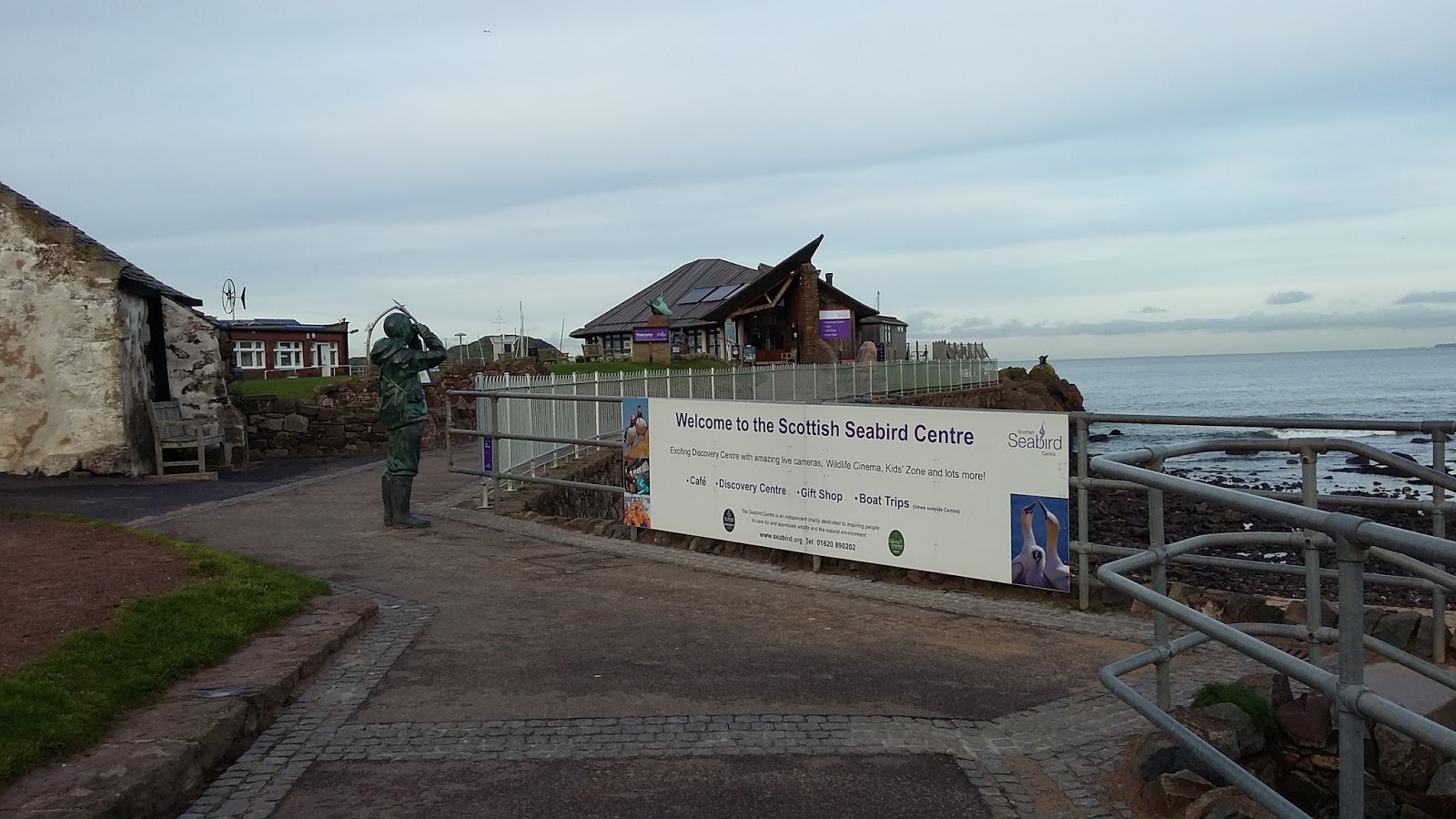
Mid-week I took a trip to the Seabird Centre in North Berwick. The last time I visited the centre I was only 15 years old and beginning to show an interest in working with nature. My dad took the family along and I remember chatting to the staff there and thinking “WOW! This is what I want to do”. Needless to say it had changed significantly since then with new displays, live feeds from the Forth islands and even a new marine tank complete with native rocky shore animals. It was fantastic to see the centre continuing to inspire new seabird fans just as it did all those years ago. Interested in learning more about the Seabird Centre check out their website including LIVE cameras from the Forth Islands: http://www.seabird.org

Scottish Seabird Centre (photo Laura Shearer)

Hermit Crab (Pagurus bernhardus) in the marine display at Seabird Centre (photo Laura Shearer)
During the autumn months grey seals (Halichoerus grypus) give birth around the UK. As a marine mammal medic for the British Divers Marine Life Rescue (BDMLR), we are called to sick or injured seal pups which may need specialist care and rehabilitation. As a result I joined other medics for a tour around the Scottish Society for the Protection of Cruelty to Animals (SSPCA) wildlife centre which has a purpose built facility for seal rehabilitation. It was excellent to see the amazing facilities they have including isolation units, specialist veterinary rooms and large pools to allow the seals to perform natural behaviours. This is the largest facility of its kind in Scotland, with the potential to support up to 100 seals at one time.

If you come across a sick or injured seal please contact the BDMLR on 01825 765546 during office hours or 07787433412 out of office hours. The SSPCA is a charity so check their website to learn more about how you can support their work: https://www.scottishspca.org/


Grey Seal pup (photo David Steel)